A N O U S H K A
PROPERTY DEVELOPMENT & RESTORATION
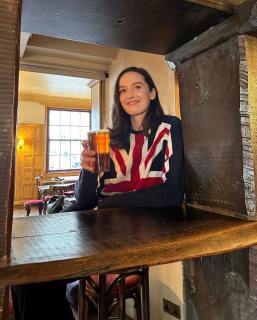






Flying the @eldoncashmere Union Jack from the best seat in the house: the lovers’ ledge that bridges two existing stanchions. The mahogany slab came from @retrouvius and was halved and sawn in order to wedge in between the stanchions.
Above the ledge is the crater of a former spotlight: a victim of my anti-downlighting policy in the pub. The cavity proved a great spot for mistletoe come December. Also in the spirit of Advent is the socket to my left, which powers the fairy lights on our Christmas tree – an essential consideration in any lighting plan.
3 years ago

The windows overlooking St Giles’ are painted in Rhomboid Red by @papersandpaints Deeply pigmented reds like this are hard to come by but, as a wise friend once told me – in the land of roast beef, a pub needs a bit of red.
Our electricians were patient enough to let me lower the wall lighting in the room by one panel. The wall lights are by @howelondon and quarter-sawn oak graining by @swrdecart
4 years ago


A portrait of an old man with a pipe sits beside a window overlooking Lamb and Flag Passage. Decades of paint was lifted from the staggered lintels by hand. The window muntins were painted black and the old man was given a picture light.
I took the painting out of its frame, as I wanted the room to feel rustic and unfussy. Two shelves were embedded beneath using leftover floorboards. The more ledges there are to rest a drink in a pub the better…
4 years ago


Celebrating the news that Listed Building Consent (LBC) has been granted for the Lamb and Flag.
Alongside drawing up the pub’s design, I drafted the LBC application for the project. The LBC is sometimes outsourced to a specialist but I found the research really complemented the design work. Both concern the building and its history. Both also concern the design proposal and its specifications.
The LBC culminates in the Heritage Statement, which considers the historical, architectural and cultural ‘significance’ of the listed building in relation to the proposal. Even in 125 pages, it was hard to summarise the legacy of a 16th-century inn that counts J. R. R. Tolkien and C. S. Lewis among its former patrons. Honoured to have the application approved today and many months of research recognised by Oxford City Council.
4 years ago


At the back of the pub is a large room that was formerly home to a darts board, a scythe and a cash machine. The plaster was rotten, and sagging sheets of plasterboard adulterated the vaulting of the ceiling. Outdoor paving stones made the room permanently cold and a Hogwarts-style chandelier flickered its orange bulbs above.
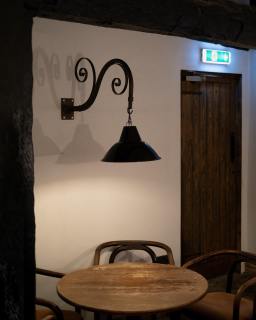
The resulting design is intentionally minimalist. I wanted to expose the original shape of the room and let the lime plaster do the talking. The fire door was re-stained and its architrave removed. This large enamel pendant light, with its scrolled, wrought-iron bracket, helps to fill the space.
4 years ago


The Snug was built in the late 1960s on the site of the old yard. At the same time, Antonín Šuman would have been designing these bentwood chairs for TON – at the Czech factory founded by Michael Thonet, who invented bentwood furniture. Thank you to @merchantandfound for sourcing 22 of them for the project.
Bentwood chairs are as common in British pubs as fake IDs. We were fortunate to inherit a well-scuffed existing suite from the previous tenants, so the new TON chairs are in good company.
4 years ago

The last orders bell at the Lamb formerly presided over the wardroom of a ship. Sourced for the project, its clapper was fitted with a new rope lanyard.
As the old saying goes, ‘he who rings the bell in jest buys a drink for all the rest’.
4 years ago


Art will never die! So avows the resting place of Canova’s heart, built by his students and erected in 1827. The pyramid shape (likely Masonic) and its half-open door were originally designed by Canova – not for himself, but for Titian.
To the right, the weeping figures of Sculpture, Painting and Architecture are trailed by three genii with torches aflame. To the left, a winged Lion (Venice) sleeps beside the genius of Antonio Canova (1757–1822) – earthly torch now extinguished.
This October the @veniceinperil.fund completed a two-year restoration of the cenotaph. Damp and saltwater had risen up into the marble causing staining and shifting of the facade.
Final pic: Alinari, Venezia – Chiesa de’ Frari Monumento a Canova, private collection.
4 years ago


Lime mortar has been used since 7000BC and remains unsurpassed in traditional construction for its drying properties. One has only to look at the Hill House Box to see what happens where cement harling is used in its place…
Lime mortar is moisture permeable. Cement is not. Using cement mortar creates a layer of impermeability that merely displaces the wet, putting greater pressure on the surrounding masonry or forcing the problem underground. The consequence is penetrating and/or rising damp. Lime mortar, on the other hand, will sacrificially protect the masonry from damp, since moisture can move freely through the capillaries in the lime, keeping the building dry. For the same reason, damp proofing – using plastic membranes, chemical injections and physical cement barriers – is a false economy and is actually a major cause of damp.
With immense dedication, Mike and Jamie @heritageplastering have transformed the walls of the Lamb and Flag. Their lime rendering and plastering articulates the contours of this 16th-century building. The result has cured our damp problem and is in itself a work of art.
4 years ago


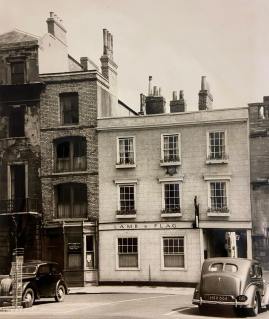
St John’s College have retained the freehold of the Lamb and Flag since 1573. Hidden away in the college archives was an unpublished picture of the Lamb in 1959. The pub was then tied to the Northampton Brewery Company (NBC), as advertised in the six-point star insignia on the St Giles’ front.
It feels like fate to have found this commemorative jug, produced for the NBC in the coronation year. The jug would have been for sale in the pub. And now it has come home again!
Photograph reproduced with kind permission of St John’s College.
4 years ago